
Why 78% of Customers Go With the First Business That Responds Data driven, high search intent
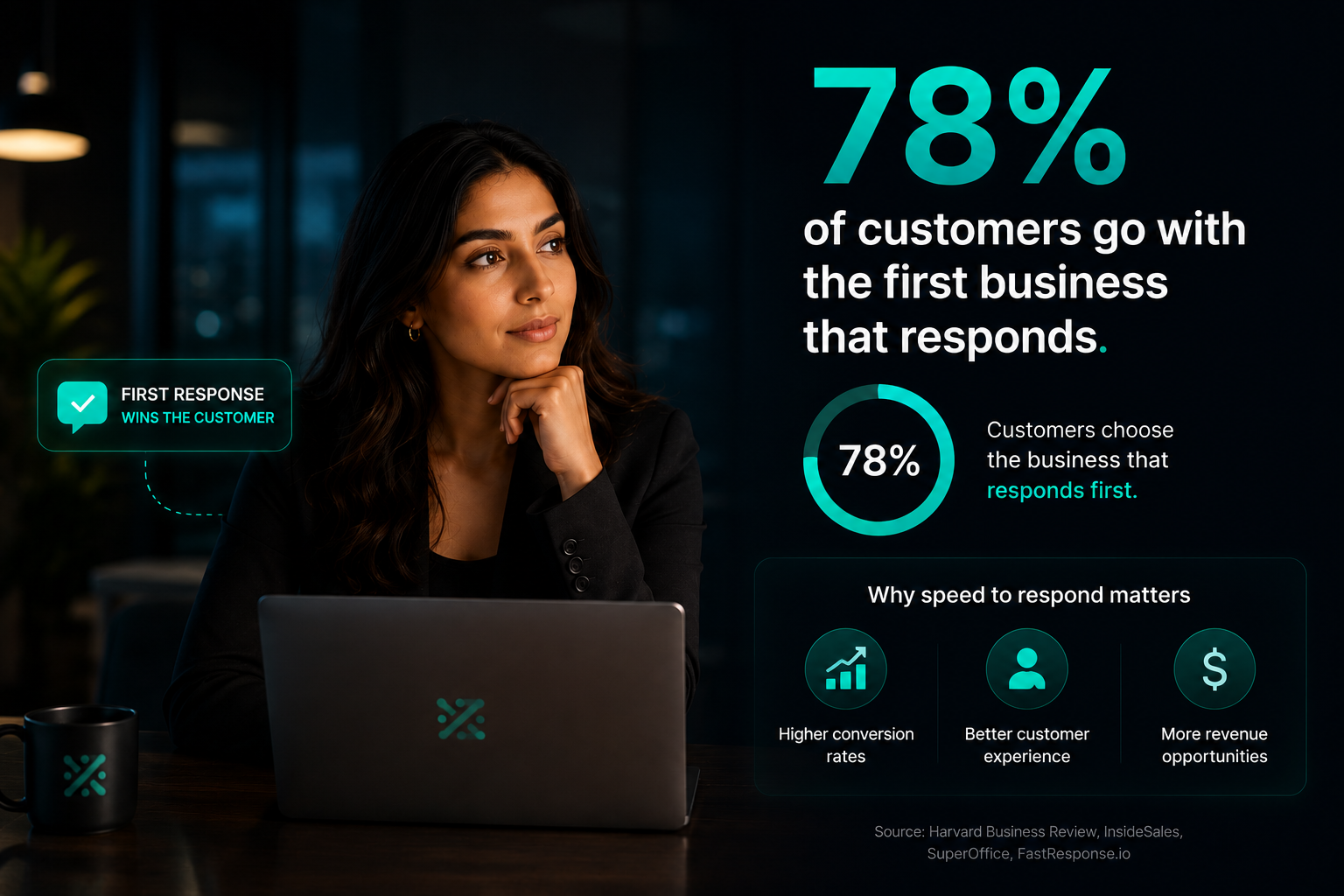
78% of customers buy from the first business that responds not the best, not the cheapest, the fastest. MIT research shows leads contacted within 5 minutes are 21x more likely to convert. Here's what the data means for your business.
The Uncomfortable Truth About Winning Customers
You might have the best product in your market.
You might have the most competitive price.
You might have hundreds of five-star reviews and a decade of experience.
None of it matters if your competitor picks up the phone first.
Research from MIT and Harvard Business Review — analyzing over 15,000 leads across multiple industries — found one statistic that should change how every business owner thinks about sales:
78% of customers buy from the first company that responds to their inquiry.
Not the best company. Not the cheapest. Not the most experienced.
The first one.
This single number explains more about why businesses lose sales than any other factor. And for most Indian businesses — where the average response time to a new lead is 42 to 47 hours — it explains exactly where their marketing budget is going.
Nowhere.
What the Research Actually Says
The data on lead response time is not just consistent — it's brutal.
Here are the numbers every business owner needs to understand:
78% of customers buy from the first company that responds to their inquiry (Lead Connect / InsideSales.com)
21x — Leads contacted within 5 minutes are 21 times more likely to be qualified than leads contacted after 30 minutes (MIT / InsideSales.com Lead Response Management Study)
391% — Responding within the first minute increases conversions by 391% compared to responding after 2 minutes (Velocify)
100x — Businesses that respond within 5 minutes are 100 times more likely to make contact than those who wait 30 minutes (MIT Study)
80% — Lead qualification rates drop by 80% for businesses that take more than 5 minutes to respond (Harvard Business Review)
42–47 hours — The average business response time to a new lead across industries (Forbes)
58% — Percentage of businesses that never respond to a lead at all (LeadResponse.co)
Read that last one again.
58% of businesses never respond to a lead at all.
Which means that in most markets, just picking up the phone — consistently, quickly, every time — puts you ahead of more than half your competition immediately.
The Psychology Behind the Statistic
Understanding why this happens is just as important as knowing that it does.
When a potential customer reaches out to your business, they are at the peak of their buying intent. Something triggered that action — an ad they saw, a problem they need solved, a recommendation from a friend. In that moment, their attention is focused, their intent is high, and they are ready to engage.
Every second that passes after that moment is a decay of that intent.
This isn't just anecdotal. It's the psychology of decision-making.
Fast response signals trust. When a business responds immediately, it tells the customer: we are organized, we value your time, and we will be there when you need us. That first interaction becomes a preview of the entire customer experience.
Slow response signals disorganization. A 48-hour callback doesn't just frustrate the customer — it actively destroys the impression that all your marketing spend worked so hard to create.
The first conversation shapes the relationship. The business that speaks to a customer first learns their needs before any competitor does. They set the tone, frame the solution, and establish a relationship that competitors must now overcome. That's an enormous advantage built simply by picking up the phone.
What Happens to Your Leads Right Now
Let's be honest about what the typical Indian business lead journey looks like.
A potential customer sees your ad — on social media, in a newspaper, on a hoarding. They're interested. They call your number or fill out your contact form.
Scenario A — Office hours, team available: Someone picks up after 4–5 rings. They take a message, say someone will call back, and transfer the details to a sales person who may or may not follow up that day.
Scenario B — Outside office hours: No one picks up. The call goes unanswered. Maybe a voicemail is left. Maybe not. Your team sees the missed call the next morning and tries to call back — but the customer has already moved on, lost interest, or found someone else.
Scenario C — The lead fills out a web form: The form submission arrives in an inbox. It sits there until someone checks it — which might be tomorrow morning, or after the weekend, or whenever someone remembers to look. The average follow-up time in India for web form leads is over 24 hours.
In all three scenarios, you are losing leads that you paid to generate.
The money you spent on that Google Ad, that newspaper placement, that social media campaign — it generated interest. But the follow-up system failed to capture it.
The 5-Minute Window That Changes Everything
The MIT Lead Response Management Study is the most referenced piece of research in the entire field of sales optimization — and for good reason.
The finding is simple and devastating:
Responding to a lead within 5 minutes makes you 21 times more likely to qualify that lead compared to waiting just 30 minutes.
Not 2 times. Not 5 times. Twenty-one times.
After one hour, the odds drop by 10 times again.
After 24 hours, the lead is essentially dead.
The window is not days. It is not hours. It is minutes.
For businesses relying on human teams to respond — teams that have lunch breaks, meetings, leave days, and working hours — hitting that 5-minute window consistently is nearly impossible.
Which is exactly why the businesses winning in this environment are not relying on humans to be the first responder.
The Indian Market Reality
The global statistics on lead response are alarming. The Indian market reality is even more stark.
India's business culture is relationship-driven. Trust is everything. And trust begins with the very first interaction a customer has with your business.
But Indian businesses face unique challenges that make fast response particularly difficult:
Operating hours vs. inquiry hours don't match. As we've seen in our own data at Zencia, a significant portion of genuine business inquiries in India happen outside standard office hours — early mornings, evenings, and weekends. These are the moments when decision makers have time to think about the services they need.
Language adds complexity. India has 22 official languages. A customer calling from Chennai might prefer Tamil. A lead from Ahmedabad might be most comfortable in Gujarati. When the person who picks up the phone doesn't speak the customer's language, trust breaks down immediately — even if the response was fast.
Volume creates inconsistency. For growing businesses, lead volume fluctuates. During peak periods, some leads get fast responses. Others wait days. The inconsistency itself sends a message to customers about how the business operates.
30% of Indian leads are never contacted at all. Across industries, roughly a third of all lead inquiries in India are simply never followed up on. This is marketing spend that generated interest and then converted into nothing.
The Competitive Advantage of Being First
Here is what being the first responder actually means in practice.
You earn trust before the conversation begins. A customer who reaches out and gets an immediate, helpful response is already impressed before a single product detail has been discussed.
You learn their needs before competitors do. The first conversation gives you information — budget, timeline, specific requirements, pain points. Competitors who respond later are starting a conversation you've already had.
You set the benchmark. The customer now compares every subsequent interaction against their experience with you. If you were professional, helpful, and fast — every slower, less organized competitor looks worse by comparison.
You close deals faster. Research from InsideSales.com shows that 35–50% of sales go to the vendor that responds first. Not because they're better. Because they got there first and set a relationship in motion.
Why Human Teams Can't Solve This Alone
The instinct of most business owners when they hear these statistics is to tell their team to respond faster.
This doesn't work.
Human teams have constraints that cannot be engineered away:
- They work fixed hours
- They have competing priorities during the day
- Response quality varies based on mood, energy, and workload
- They can only handle one call at a time
- They take sick days, holidays, and leave
- Training takes time and consistency is never guaranteed
You can set targets. You can monitor response times. You can hire more people.
But you cannot make a human team available at 7 AM on a Sunday when a customer calls after seeing your ad in the morning newspaper.
And that is exactly when some of your best leads are calling.
How AI Changes the Equation
This is the problem that AI voice agents were built to solve — not as a replacement for human relationships, but as the first line of response that ensures no lead is ever lost to silence or delay.
Echo by Zencia responds to every inquiry in under 60 seconds. Not sometimes. Every time.
At 7 AM. At 11 PM. On Sunday. On a national holiday. During Diwali. During your team's annual offsite.
And it doesn't just pick up — it has a real conversation.
It qualifies the lead by asking the right questions — budget, timeline, specific requirements.
It books the appointment directly into your sales team's calendar — while the customer is still on the call.
It follows up with a confirmation message and a reminder before the meeting.
It logs every interaction — full transcript, call recording, lead score — into your CRM automatically.
And it does all of this in 40+ languages, including 10+ Indian languages, switching mid-conversation if needed.
Your sales team then receives a fully qualified lead with complete context — and they walk into every conversation already knowing what the customer needs.
The Math Is Simple
Let's make this concrete.
If your business generates 100 leads per month and currently responds to all of them within 24–48 hours:
- You are likely qualifying fewer than 27% of those leads (industry average)
- You are losing approximately 73 out of every 100 leads you paid to generate
- 58% of your competitors are not responding at all — so even modest improvement puts you ahead
Now imagine responding to all 100 leads within 60 seconds:
- Lead qualification rates increase by up to 100x (MIT Study)
- You are first to engage on every single inquiry
- 78% of customers who were comparing options choose the first responder
The revenue difference between those two scenarios — same number of leads, same product, same price — is the entire gap between a business that struggles and one that scales.
Getting Started
The good news: fixing your lead response time does not require hiring more staff, restructuring your team, or spending months on implementation.
With Zencia Echo, you can deploy an AI voice agent that responds to every call within 60 seconds — in your customers' language, 24 hours a day — in under 24 hours.
Step 1: Connect your existing phone number, CRM, and calendar.
Step 2: Configure your AI agent with your business context, qualification criteria, and booking rules.
Step 3: Deploy and start capturing every lead — including the ones that were calling after hours and going unanswered.
The Bottom Line
The research is consistent across every study, every industry, and every market:
Speed wins.
Not quality alone. Not price alone. Not reputation alone.
The business that responds first wins 78% of the time.
Every hour your leads go unanswered is an hour your competitor has to pick up that call instead.
The question is not whether you can afford to respond faster.
The question is how many more leads you can afford to lose.
Ready to be the first responder — every time?
Echo by Zencia picks up every call, in every language, in under 60 seconds. 24/7.
Sources: MIT / InsideSales.com Lead Response Management Study · Harvard Business Review · Velocify · Lead Connect · Forbes · LeadResponse.co