
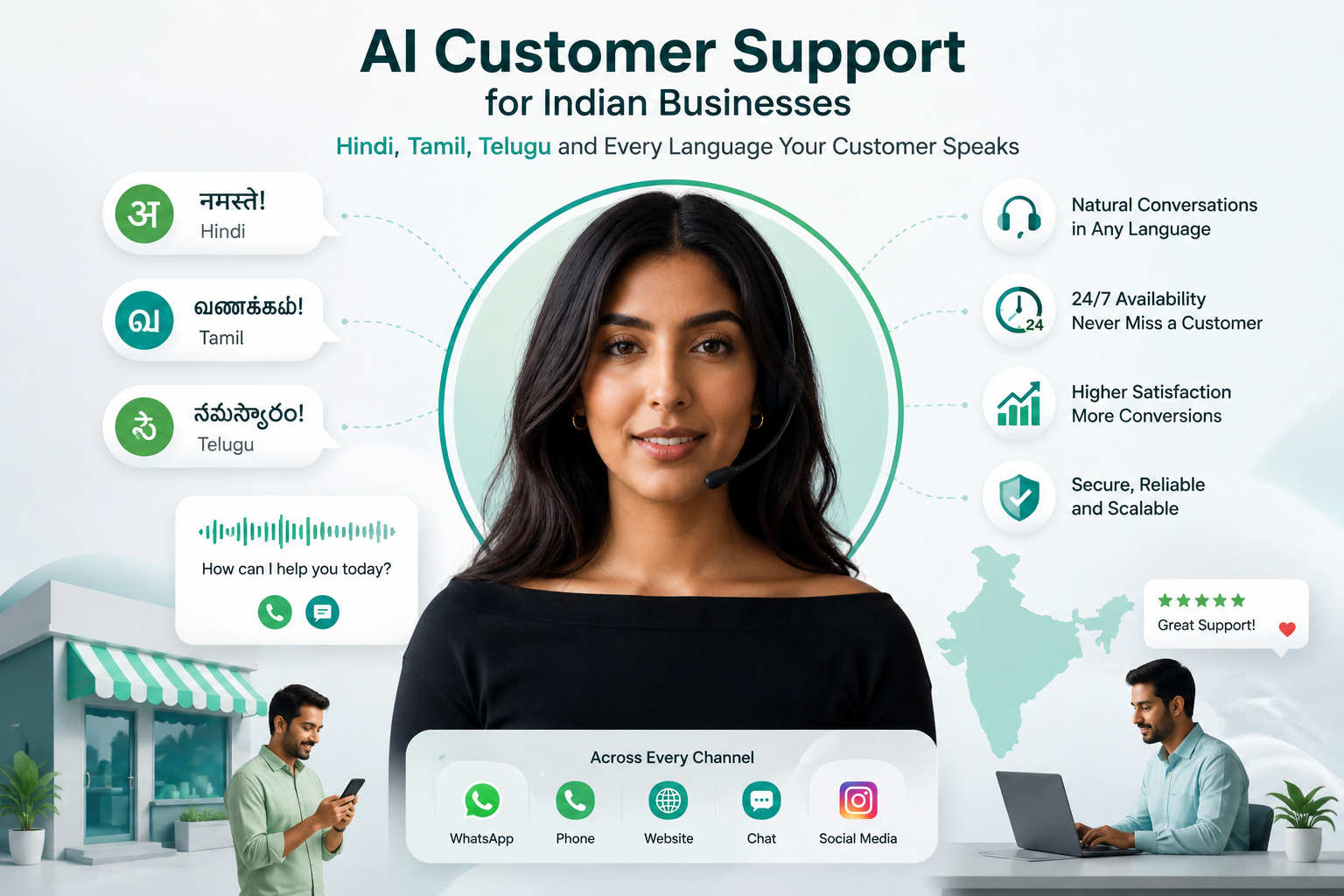
AI Customer Support for Indian Businesses Hindi, Tamil, Telugu and Every Language Your Customer Speaks
India speaks 14 languages. Your customers speak the one they grew up in, especially when they have a problem and need help. Here is how AI customer support makes it possible to serve every Indian customer in Hindi, Tamil, Telugu, Bengali, Kannada, Malayalam and 8 more languages, 24/7, at scale.
The Language Problem Nobody Talks About
A customer calls your support line.
They speak Tamil.
Your support agent speaks Hindi.
What happens next is not a customer support interaction. It is a frustration exercise.
The customer repeats themselves. The agent apologises. Someone transfers the call. Hold music plays. The customer hangs up.
That customer does not call back. They leave a bad review. They tell three friends.
This scenario plays out thousands of times every day across Indian businesses in call centres, on WhatsApp, on website chat widgets, and in support queues.
Not because the business doesn't care. Because India speaks 14 major languages and most customer support systems were built for one.
India's Language Reality
India is not a single language market.
It never was.
The Constitution of India recognises 22 official languages. But in business, 14 Scheduled Languages dominate customer communication across different regions:
LanguagePrimary RegionSpeakersHindi (hi)North India UP, Bihar, MP, Rajasthan, Delhi600M+Bengali (bn)West Bengal, Bangladesh border states100M+Telugu (te)Andhra Pradesh, Telangana95M+Marathi (mr)Maharashtra90M+Tamil (ta)Tamil Nadu, parts of Karnataka, Kerala80M+Gujarati (gu)Gujarat, parts of Rajasthan60M+Urdu (ur)UP, Bihar, Hyderabad, J&K55M+Kannada (kn)Karnataka50M+Odia (or)Odisha45M+Malayalam (ml)Kerala38M+Punjabi (pa)Punjab, Haryana, Delhi35M+Assamese (as)Assam, Northeast India15M+Maithili / Nepali (ne)Bihar border, Sikkim, hill states14M+Sindhi (sd)Rajasthan, Gujarat, Maharashtra3M+
Every one of these languages represents a customer base.
A real estate company in Hyderabad needs Telugu support. A healthcare clinic in Chennai needs Tamil support. A logistics business in Ahmedabad needs Gujarati support. A bank with pan-India operations needs all of them.
Most Indian businesses support one or two. The rest of their customers make do or move on.
Why English-Only or Hindi-Only Support Fails in India
The instinct of most Indian businesses when setting up customer support is to default to English or at best Hindi and English.
This fails for three reasons.
1. Most Indian customers are not comfortable in English
India has approximately 125 million English speakers. That sounds like a lot until you realise India has 1.4 billion people. That means roughly 1.275 billion Indians 91% of the population are not comfortable communicating in English for something as important as a support interaction.
For routine transactions, English might be manageable. But when a customer has a problem a delayed delivery, a billing dispute, a medical query, a property concern they need to communicate in the language they think in. Not the language they studied in school.
2. Hindi is not India's universal language
A common misconception is that Hindi covers most of India. It does not.
Tamil Nadu, Kerala, Karnataka, Andhra Pradesh, Telangana, West Bengal, Odisha, Assam, Maharashtra these states have strong regional language identities. In many of these regions, customers actively prefer their regional language over Hindi. Forcing Hindi-only support in Chennai or Kochi is not just ineffective it can be perceived as culturally dismissive.
3. Language affects trust, not just comprehension
Research consistently shows that customers who receive support in their native language report higher satisfaction, trust the brand more, and are more likely to remain customers.
This is not just about understanding what is being said. It is about feeling heard. Feeling respected. Feeling like the company made an effort to meet them where they are.
In India, where relationships and trust are central to commerce, this is not a minor detail. It is a competitive advantage.
The Cost of Multilingual Human Support
Understanding the problem is step one. The harder question is: what do you do about it?
The traditional answer is to hire multilingual agents. Staff your support team with people who speak Tamil, Telugu, Kannada, Malayalam, Bengali, and Gujarati in addition to Hindi and English.
This sounds reasonable until you run the numbers.
Hiring costs: A multilingual customer support agent who speaks Telugu and English, for example, commands a premium over a single-language agent. Multiply this across 10+ languages and the cost becomes significant.
Availability: Human agents work 8-9 hour shifts. Your customers in Kerala call at 10pm. Your customers in Assam have urgent queries on Sunday morning. Human teams cannot cover every language at every hour.
Consistency: Agent quality varies. A frustrated agent on a Monday morning and the same agent on a Friday afternoon deliver different experiences. Training helps but does not solve the consistency problem entirely.
Scalability: When call volume spikes during a product launch, a billing cycle, a seasonal peak human teams cannot scale instantly. Customers wait. Satisfaction drops.
Attrition: Customer support has one of the highest attrition rates of any function in Indian businesses. Every time a trained multilingual agent leaves, knowledge walks out the door with them.
The math does not work at scale.
What AI Customer Support Makes Possible
AI-powered customer support does not replace the human relationship at the heart of Indian commerce.
It makes that relationship possible at a scale that human teams alone cannot achieve.
Here is what AI customer support delivers for Indian businesses across all 14 major languages:
Instant response in any language
A customer writes to you in Odia. An AI agent responds in Odia within seconds, at any hour, with the same quality of response as a trained support agent.
No hold music. No language mismatch. No transfer to a different team.
Natural conversation not translation
The critical distinction: good AI customer support does not translate a Hindi script into Tamil. It understands Tamil natively the grammar, the formality levels, the regional variations, the cultural context.
A customer in Chennai saying "Enna panradhu theriyalai" is not just saying "I don't know what to do" in Tamil. They are expressing frustration and confusion in a culturally specific way. An AI agent that understands this responds with empathy appropriate to the emotion not a robotic translation of a standard response.
Code-switching and Hinglish
Urban Indian customers particularly millennials and Gen Z do not speak in pure Hindi or pure English. They speak Hinglish. They switch between languages mid-sentence.
"Mera order 3 din se pending hai, it's really frustrating yaar."
AI customer support that handles only one language at a time fails here. AI that understands code-switching and responds naturally in the same mixed register succeeds.
24/7 availability across all languages
The most powerful advantage: your Telugu support does not go home at 6pm. Your Kannada agent does not take Sunday off. Your Bengali customer service does not have a lunch break.
Every language. Every hour. Every day.
Consistent quality
Every customer in every language receives the same quality of support. The response to a Gujarati customer at 2pm and the response to a Marathi customer at 2am are equally good. Equally professional. Equally helpful.
Instant scaling
One hundred customers contacting you simultaneously in five different languages. AI handles all of them in parallel, instantly, without degradation in quality.
Use Cases Across Indian Industries
Real Estate
A property developer in Hyderabad receives inquiries from buyers across Telangana and Andhra Pradesh primarily in Telugu. Buyers ask about property specifications, pricing, possession dates, and EMI options.
With multilingual AI support, every Telugu-speaking buyer gets an instant, detailed response in their language. Qualified buyers are identified and connected to sales agents. Site visits are booked automatically.
The developer's human team focuses on high-value conversations negotiations, site visits, closing not answering the same ten questions in Telugu fifty times a day.
Healthcare
A hospital group operates across Maharashtra, Karnataka, and Tamil Nadu. Patients call in Marathi, Kannada, and Tamil to ask about appointments, test results, billing, and ward information.
With AI customer support, every patient query in every language is handled instantly appointment bookings, report status checks, billing FAQs, ward and doctor information. Urgent queries are routed to medical staff immediately. Routine queries are resolved without any human involvement.
Patient satisfaction improves. Front desk load decreases. Staff focus on care, not repetitive information requests.
Banking and Financial Services
A fintech company serves customers across India from UP to Kerala, from Assam to Gujarat. Customers have queries about their accounts, transactions, loan status, and repayment schedules.
AI customer support handles these queries in Hindi, Bengali, Assamese, Odia, Gujarati, Marathi, Kannada, Malayalam, Tamil, Telugu, and Punjabi simultaneously, accurately, and instantly.
Customers feel served in their own language. Trust in the brand increases. Support costs decrease.
E-commerce and Retail
An e-commerce brand ships pan-India. Customer queries about orders, returns, refunds, and delivery are among the highest-volume support interactions in any retail business.
Multilingual AI handles order tracking in Bengali for Kolkata customers, return requests in Tamil for Chennai customers, and delivery queries in Gujarati for Ahmedabad customers all without a single human agent involved.
Resolution time drops from hours to seconds. Customer satisfaction scores rise. Support costs are a fraction of a human team at equivalent scale.
Education
An edtech company offers courses across India. Students and parents call in their regional languages Odia from Bhubaneswar, Punjabi from Chandigarh, Nepali from Sikkim with questions about courses, fees, schedules, and results.
AI handles every query in every language, 24 hours a day because students study at night and parents call on weekends.
The 14 Languages Zencia Supports
Zencia's AI customer support agents communicate natively across all 14 major Indian Scheduled Languages:
Assamese (as) Northeast India, Assam Bengali (bn) West Bengal, border states Gujarati (gu) Gujarat, parts of Rajasthan Hindi (hi) North India, national reach Kannada (kn) Karnataka Malayalam (ml) Kerala Marathi (mr) Maharashtra Nepali (ne) Sikkim, hill states, Bihar border Odia (or) Odisha Punjabi (pa) Punjab, Haryana, Delhi Sindhi (sd) Rajasthan, Gujarat, Maharashtra Tamil (ta) Tamil Nadu, parts of South India Telugu (te) Andhra Pradesh, Telangana Urdu (ur) UP, Bihar, Hyderabad, J&K
Plus English and the Hinglish code-switching that defines how urban India actually communicates.
What Good Multilingual AI Support Looks Like
Not all multilingual AI is equal. Here is what separates AI customer support that actually works in India from systems that fail in the field:
Native language understanding not translation The AI must understand each language natively, not translate to English to process and then translate back. Translation-based systems lose nuance, cultural context, and emotional tone.
Regional accent recognition Hindi in Lucknow is not Hindi in Delhi. Tamil in Chennai is not Tamil in Coimbatore. The AI must handle regional pronunciation and accent variation not just textbook language samples.
Formality awareness Indian languages have formal and informal registers that carry significant social meaning. Addressing a customer incorrectly too formally or too casually signals that the system does not understand their context.
Cultural context Responses must be culturally appropriate not just linguistically correct. This includes understanding regional customs, communication styles, and the implicit meaning behind how different communities phrase their concerns.
Seamless escalation When a query genuinely requires human judgment, the AI must hand off smoothly with full context of the conversation to the right human agent, in the right language.
Getting Started
Deploying multilingual AI customer support for your Indian business does not require months of implementation or significant infrastructure investment.
With Zencia, you can deploy AI customer support across all 14 Indian languages in under 24 hours.
Step 1: Connect your existing support channels phone, WhatsApp, website chat, email.
Step 2: Configure your AI agent with your business context, common queries, and resolution workflows for each language market you serve.
Step 3: Deploy and start serving customers in every language instantly, 24/7.
Step 4: Scale as your business grows. Add languages, add channels, add capacity without adding headcount.
The Bottom Line
India speaks 14 languages.
Your customers speak the language they grew up in especially when they have a problem and need help.
Businesses that serve customers in their own language build trust faster, resolve issues faster, and retain customers longer.
AI makes it possible to do this at scale across every language, every channel, every hour without the cost and complexity of multilingual human teams.
The question is not whether multilingual support matters in India.
The question is how much longer you can afford to offer it to only some of your customers.
Zencia's AI agents support all 14 major Indian languages natively, culturally, and in real conversation.